What is Dual Mobility?
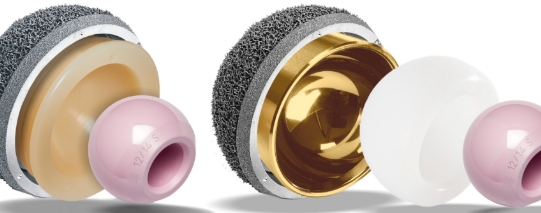
A conventional hip replacement uses an articulation between the femoral head and the acetabular component.
In contrast, a dual-mobility design adds a second articulation. With this design, the smaller femoral head moves inside a larger polyethylene insert, while the insert can also move inside the acetabular shell. As a result, the construct creates two points of articulation.
Why Does That Matter?
The dual articulation can increase jump distance, which is the amount of movement required before the femoral head can move far enough to dislocate. Your presentation describes jump distance as an important benefit of the design.
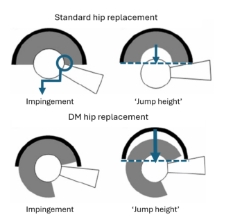
Research also describes increased jump distance and range of motion before impingement as mechanisms contributing to the stability of dual-mobility designs.
MDM’s Modular Design
Adaptable
Can be used in primary and revision procedures.
Modular
Can pair with compatible acetabular shells and femoral components.
Integrated
Designed to work with several Stryker acetabular shell systems identified in your presentation.
Enhanced Stability
Two points of articulation contribute to increased jump distance.
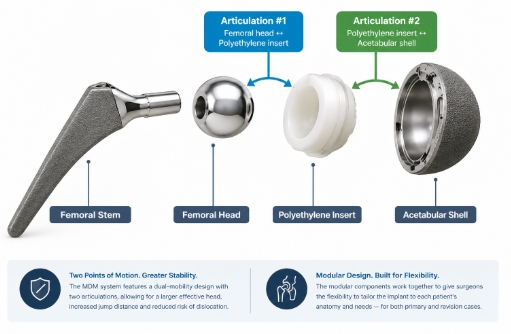
The MDM construct uses different materials for its components. The MDM liner is made from cobalt-chromium (CoCr), while the insert uses X3 polyethylene. These materials are designed to work together within the dual-mobility construct, with the polyethylene insert providing the mobile bearing between the femoral head and acetabular shell.
Modular Dual Mobility Implant
© 2026 EBMP LLC